

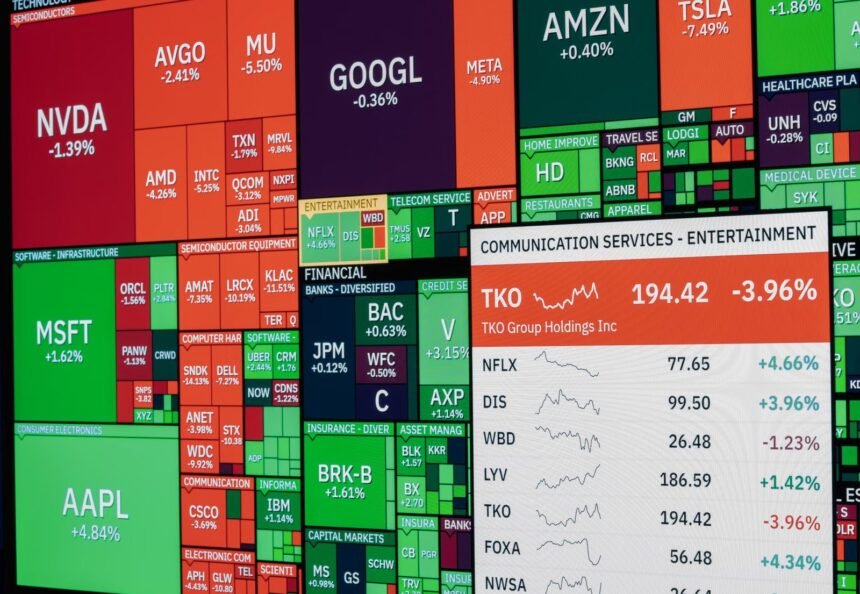
sp500: October 30 Market Update Remains Unverified
The sp500 update for October 30, 2026, remains incomplete: no closing result for that session was verified in this review. Some reporting is accessible, however, so the earlier claim that no readable market coverage was available needs correcting. Readers in the United States should distinguish confirmed observations from an unverified final result.
The supplied research leads offer uneven evidence. One contains a readable excerpt about Thursday’s trading, while two company research pages could not be retrieved. Additional reporting supplies an intraday observation for Friday. These pieces establish more than a complete information gap, but they do not establish Friday’s closing level.
What is verified about the sp500 update?
The accessible Seeking Alpha excerpt reports that the S&P 500 finished Thursday down 0.3%. Separately, Associated Press reporting describes a Friday decline of 1.1% at 10 a.m. Eastern time. Those are observations from different sessions and stages of trading; neither establishes the October 30 closing result.
The Friday figure is an early snapshot, not a completed daily return. AP describes technology weakness outweighing gains elsewhere. That supports a bounded account of trading at the stated time, while leaving the eventual outcome unresolved. This article does not convert that snapshot into a prediction about the close.
What do the supplied research links establish?
The Seeking Alpha page provides a partial account of Thursday’s market performance, but its full preview was not readable. The two Yahoo Finance research links returned retrieval errors. Their supplied titles identify company forecasts, but the underlying analysis, assumptions and publication details could not be independently checked here.
Seeking Alpha’s “3 things to look out for on Friday” is therefore useful only within the limits of its accessible text. The Yahoo Finance leads concern Solventum and Meta Platforms. A company name in a research title does not establish that business’s role in an index move.
Forecasts also answer a different question from market quotations. An analyst’s outlook concerns possible future performance; a dated price records an observation. Treating either company report as evidence of Friday’s broad market direction would require information that the inaccessible pages did not supply during this review.
How can the index fall while many stocks rise?
The S&P 500 uses float-adjusted market capitalization weighting, giving companies unequal influence over its movement. Losses among heavily weighted constituents can outweigh gains across numerous smaller constituents. A declining benchmark therefore does not establish that most included stocks fell, just as a rising benchmark does not demonstrate widespread gains.
S&P Dow Jones Indices publishes the methodology behind that weighting. Market breadth provides a separate view by counting advancing and declining stocks. The benchmark’s percentage change measures weighted performance, while breadth describes participation. The two measures can point in different directions without either being incorrect.
Explaining a specific session still requires evidence about that session. A familiar structural feature cannot, by itself, identify which companies caused a particular decline. Constituent price changes and their index weights matter together; the largest percentage loss is not automatically the largest contribution to the benchmark’s fall. You can also explore Do Not Exit: Confusing Road Markings Spark Debate for more options.
What separates futures, intraday prices and closing levels?
Futures are contracts linked to an index, while an intraday index reading records its value during the cash session. A closing level describes the completed session. These observations cannot substitute for one another: an overnight futures decline does not establish a lower close, and an early cash-market loss can reverse.
For the sp500 report, the instrument and observation time are essential parts of any numerical claim. A percentage change also needs a comparison point. Figures measured against a previous cash close and figures measured against a futures settlement describe different comparisons, even when both appear in market coverage.
Publication dates need similar care. A Friday article can discuss Thursday’s close, Friday’s expected events or trading already underway. Reading the date without the quoted market time can merge separate developments into one story. The accessible Thursday result should remain explicitly attached to Thursday.
What evidence is needed to explain a market move?
A supported explanation connects an observed market move with documented developments and contemporaneous reporting. Earnings, economic releases and policy announcements can provide relevant context, but timing alone does not establish causation. Company results may coincide with an index decline without explaining its full size, timing or distribution across stocks.
Earnings reports also require distinguishing actual results from expectations and forward guidance. Revenue or profit growth can accompany a falling share price when expectations were higher. These distinctions explain why a company forecast cannot replace evidence of an observed market reaction. They do not establish any additional October 30 event.
Frequently Asked Questions
Is there a confirmed sp500 closing result for October 30 here?
No October 30, 2026, closing result was verified in this review. Accessible reporting includes an early Friday market observation and a separate Thursday result. A confirmed Friday close would require a quotation explicitly identified as the completed session’s result, with the correct trading date and a clear comparison point.
Do company stock forecasts establish the index’s direction?
No. A company forecast describes an outlook for an individual business or its shares, rather than the benchmark’s observed performance. Establishing index direction requires a dated market reading. Explaining that direction requires further evidence about constituent movements and relevant developments, which the inaccessible company research pages could not provide here.
Does an unavailable article mean its claims are false?
No. An unavailable article creates a verification limitation, not proof that its claims are false. The appropriate conclusion is that the contents remain unchecked through that source. Evidence available elsewhere may resolve a claim, but a retrieval error alone cannot confirm or disprove the underlying financial information.