
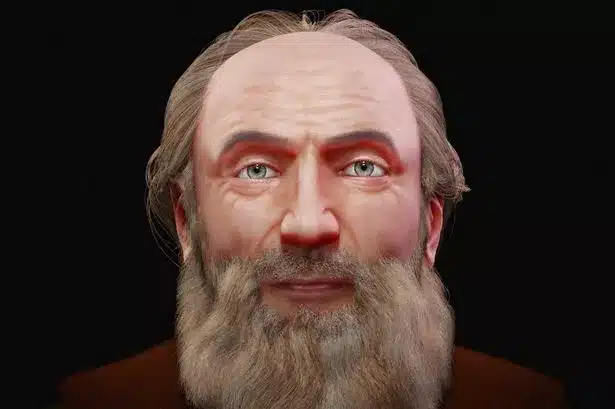
A digital reconstruction has brought the face of Ivan the Terrible, one of Russia’s most infamous rulers and History’s ‘Cruelest Man’, back into focus.
A Look Through Time of History’s ‘Cruelest Man’
“It was like peering into the past,” said Cicero Moraes, the Brazilian graphics designer who brought this project to life in a YouTube video. Moraes is known for his expertise in digitally recreating historical figures, having previously tackled subjects like the “gilded lady” mummy and even the alleged richest man to ever live.
From Bones to Bust
Ivan the Terrible, who died in 1584 after a reign marked by brutality and paranoia, has long been shrouded in mystery. To reconstruct his face, Moraes turned to the work of Soviet researcher Mikhail Gerasimov, who had scientifically excavated the Tsar’s tomb.
“Gerasimov’s studies revealed a man who lived a life of excess,” Moraes explained in the video. “Excessive eating and alcohol abuse likely contributed to his condition in his later years.” Interestingly, the analysis also revealed high levels of mercury in Ivan’s body, potentially from a medical attempt to treat an illness, although poisoning remains a possibility.
Using this information as a foundation, Moraes employed facial reconstruction techniques. He started with data from living donors to create a realistic approximation of Ivan’s skin thickness based on his skull measurements. These “donor faces” were then digitally manipulated to match the dimensions of Ivan’s skeletal structure.
The Final Image
The culmination of this meticulous process? A digital bust depicting a “strong” and “determined” man with a receding hairline and graying beard and hair. This depiction stands in stark contrast to descriptions of a younger Ivan – “tall, handsome, with broad shoulders and a pleasant face.”
More intriguing still, Moraes’ research suggests the “terrible” Tsar’s reputation might be exaggerated. “While there’s evidence to support his infamous title,” he explains, “other sources suggest his cruelty may have been embellished by his enemies.”
This digital reconstruction of History’s ‘Cruelest Man’ not only offers a glimpse into Ivan’s physical appearance. It also prompts a deeper exploration of his legacy, challenging long-held perceptions of the man and his reign.
Also read, Windows Says “Nope!” Millions Left Staring at the Blue Screen of Death
Forensic Science Rebuilds 16th-Century History
Ivan IV Vasilyevich, notoriously remembered as Ivan the Terrible, consolidated Russian power during the 16th century while establishing an autocratic reign characterized by intense paranoia and violence. Using advanced photogrammetry, high-resolution skull scans, and anatomical forensic data, international 3D designer Cícero Moraes successfully reconstructed Ivan’s true physical likeness.
The forensic reconstruction revealed a visibly deteriorated, exhausted countenance reflecting the Tsar’s harsh lifestyle, chronic ailments, and heavy mercury treatments commonly administered for pain and illness during the Renaissance. The digital model replaces centuries of romanticized paintings with an evidence-based biological portrait.
Frequently Asked Questions
How did scientists reconstruct Ivan the Terrible’s face?
The team utilized cranial measurements taken during the Soviet excavation of Ivan’s tomb in the Kremlin’s Cathedral of the Archangel in 1963, combining historical data with modern digital muscle and tissue depth algorithms.
Why was he called “Ivan the Terrible”?
In Russian, the epithet “Grozny” translates more accurately to “formidable,” “inspiring fear,” or “awe-inspiring,” rather than simply evil or bad, though his later reign was marked by brutal purges.
Discover more fascinating historical breakthroughs and viral science stories on MYVIRALBOX.